
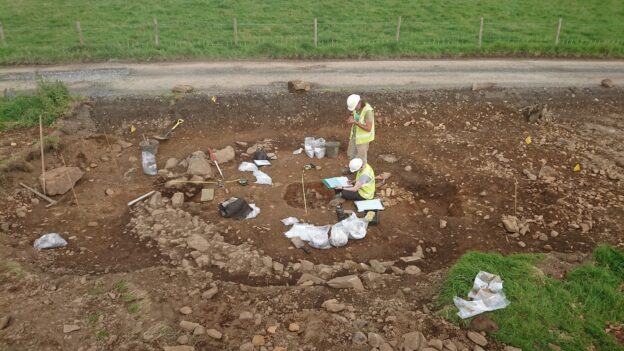
Newly published research by GUARD Archaeology has revealed a mysterious mass burial event in the Nithsdale hills some 3,300 years ago.
The archaeological excavations were undertaken in 2020 and 2021 by GUARD Archaeology during the construction of the access route to Twentyshilling Wind Farm across an area of open rough upland terrain to the south of Sanquhar in Dumfries and Galloway.
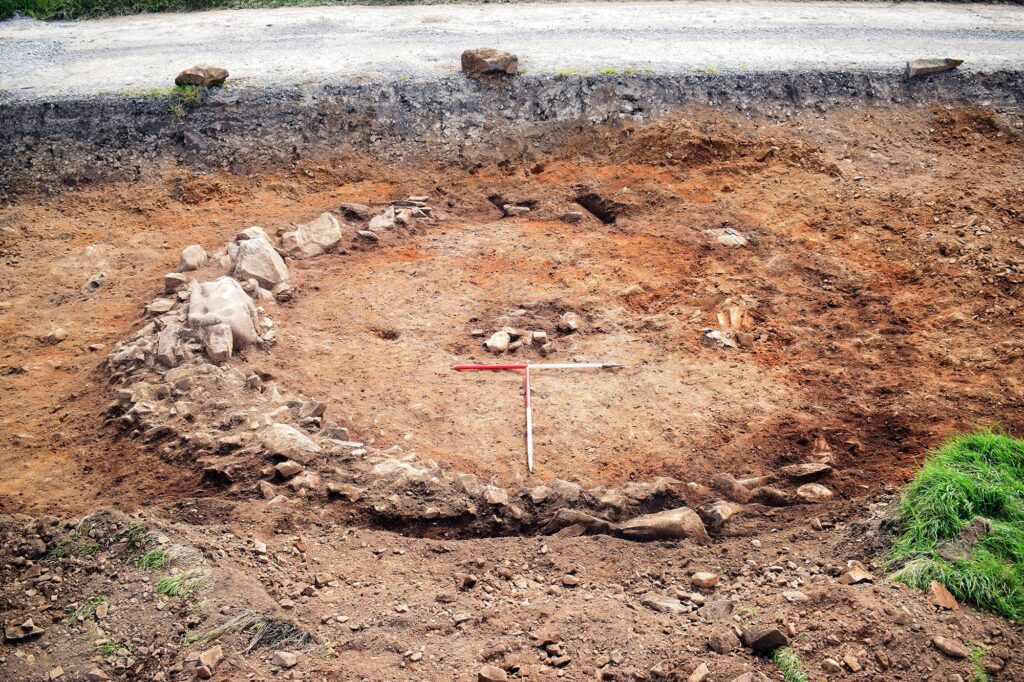
The fieldwork revealed a Bronze Age barrow. Post-excavation analyses revealed that the five closely packed urns found in a pit within the centre of the barrow contained the cremated bones of at least 8 individuals. They were placed there during one mass burial event sometime between 1439 – 1287 BC.
A small group of pits some distance north was also excavated, revealing late Neolithic activity between 2867 – 2504 BC.
The discovery of a Bronze Age Barrow and an earlier Neolithic pit group was a relative surprise as there was very little evidence of prehistoric activity in the immediate area prior to the Twentyshilling Hill fieldwork. This new archaeological evidence provides a unique glimpse into the prehistoric landscape south of Sanquhar, a landscape lightly peppered with unexplored and undated cairns and earthworks but until now, very little tying any specific part of the landscape to any particular period of time.
The work at Twentyshilling has shown that the area was sparsely inhabited by Neolithic people with a certain amount of ancestral knowledge bringing people back to the same spot for reasons long lost to us today. The barrow suggests a more settled occupation of the area during the Bronze Age with ties to the landscape as well as shared cultural links with much of Scotland demonstrated in their customs of burying their dead, such as the combination of an adult and a juvenile within each urn.
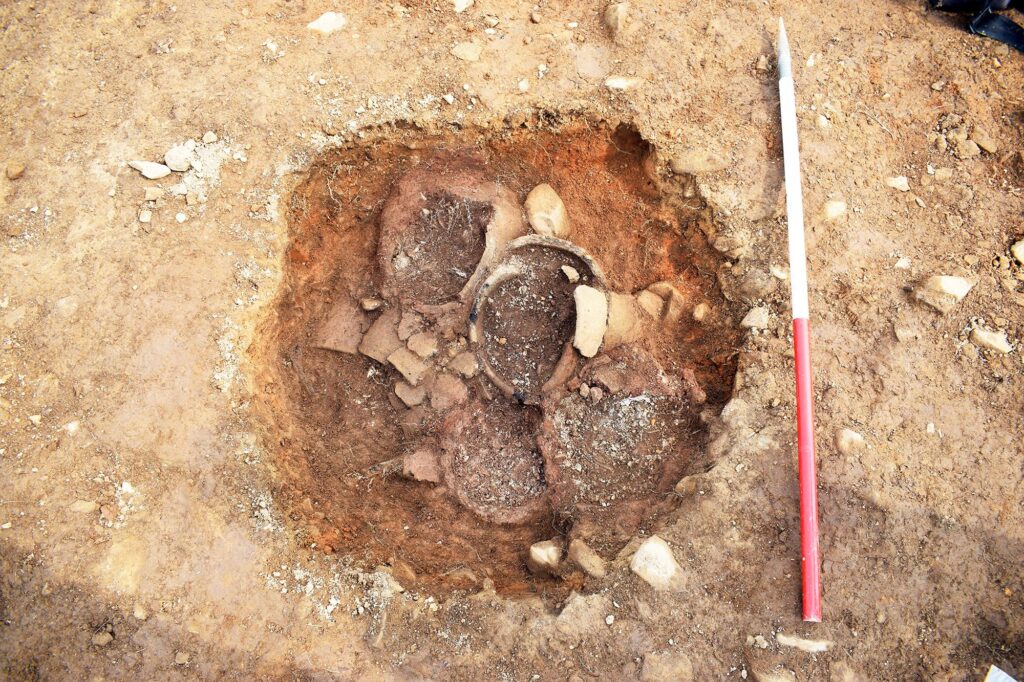
The five urns in the Twentyshilling Barrow contained at least eight individuals. The urns were deposited at the same time as they were packed tightly within the pit and adhered to the same fifteenth to thirteenth century BC date range. This indicates that this was a single mass burial, possibly of the same family or group.
The bodies of the deceased at Twentyshilling had not been left out for a lengthy period of time to partially decay, as is common in other barrows. This also indicates that they were interred at once, rather than over a longer period of time. At Broughton in the Scottish Borders, another barrow GUARD Archaeologists have excavated in recent years, the bodies of the deceased had all been exposed for a long time prior to cremation indicating an extended period of time between death and interment. And at Broughton as in many other Bronze Age barrows in Scotland, the burials were inserted over a protracted period, not all at once.
This was not apparent at Twentyshilling, perhaps because the local community here had less time to perform the burial rituals. The Bronze Age in Dumfries and Galloway may have been a time of particular stress as other burials, such as at Blairbuy in the Machars show evidence of famine and abandonment.
The archaeological work was funded by R J McLeod and Statkraft in advance of the Twentyshilling Wind Farm. It was required as a condition of planning consent by Dumfries and Galloway Council who are advised on archaeological matters by the Dumfries and Galloway Council Archaeology Service.
ARO64: Twentyshilling Hill Bronze Age Barrow, Dumfries and Galloway by Thomas Muir, with contributions by Torben Ballin, Beverley Ballin Smith, Susan Ramsay and Alun Woodward is freely available to download from Archaeology Reports Online.