
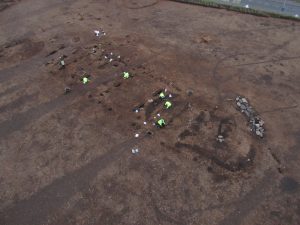
 On 17 February 2017, the GUARD Archaeology team completed their excavation of the archaeological remains at Balmachie Road, Carnoustie. Altogether they had recorded the remains of up to 12 sub-circular houses that probably date to the Bronze Age along with the remains of two rectilinear halls that likely date to the Neolithic period. The Neolithic features are significant in themselves, and include the largest Neolithic Hall ever found in Scotland. The hoard was buried in a pit close to a roundhouse that cut through the large Neolithic hall.
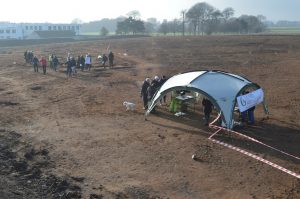 Over the previous six months, the Carnoustie excavation had received a lot of interest. Not least from teachers and pupils at Carnoustie High School, which lies adjacent to the site. So GUARD Archaeologists had led guided tours of the excavation to 200 pupils and teachers from Carnoustie High School and other schools in Angus. Following requests from Angus Council, GUARD Archaeology were also able to offer week-long work placements to two pupils from Carnoustie High School and Brechin High School Community, who are interested in studying archaeology at University. The Carnoustie excavation ended with Open Days and guided tours of the site over the last two days of the excavation in February 2017 attended by over 200 people.
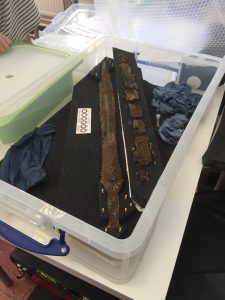 Normally post-excavation analyses of artefacts recovered from excavations only begins once the entire excavation has been completed. But in the case of the Carnoustie hoard, specialist analyses was required as soon as possible. This was because the organic remains within the hoard were so delicate and fragile that there was a danger that they would degrade within a very short time. They urgently needed conservation but before this could take place, specialists required to examine the remains and take appropriate samples for scientific testing (such as radiocarbon dating, isotope analyses, X-ray Fluorescence analyses) to extract crucial information about the artefacts.
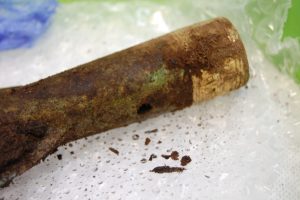 So post-excavation analyses of the hoard begins in January 2017 with a
 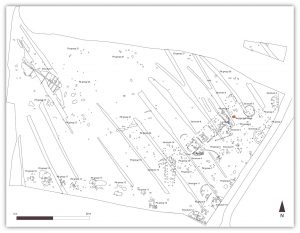 As the machine excavation of topsoil continued to reveal archaeological features so the archaeological excavation area continued to expand until by December 2016, the GUARD Archaeology team of nine archaeologists had discovered around 1000 archaeological features spread over a 17,700 sqm area.
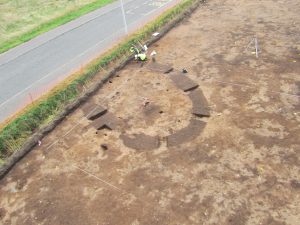 These features comprise numerous pits, post-holes and ditches. Many of these features are clustered together in patterns that can be recognised as house structures of various shapes, from elliptical, round and rectangular. From the various artefacts (pot sherds and flints mainly) that are beginning to be recovered, these houses appear to be prehistoric.
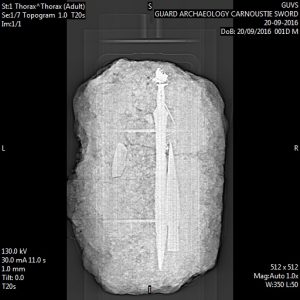 The soil block was then CT-scanned and x-rayed by the School of Veterinary Medicine at the University of Glasgow, with assistance from Gawain Hammond, Head of the Diagnostic Imaging Unit, and his team. The scan and x-ray provided valuable information and imagery to assist in the recovery of the items from the soil block. The x-ray shows that the bladed artefact is a sword and the gold decorated object is a large spearhead. But the x-ray also shows a pin lying across the handle of the sword.
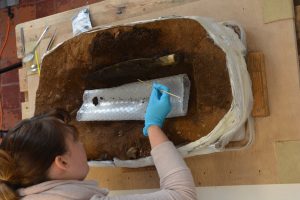 This excavation is one of the few times such a Bronze Age hoard has been undertaken in laboratory conditions. This is enabling every tiny scrap of artefact to be carefully recovered and recorded. The excavation has recovered, along with the sword and spearhead, a bronze pin and scabbard fittings (a chape to protect the tip of the scabbard and a ring that may have connected the scabbard to a belt.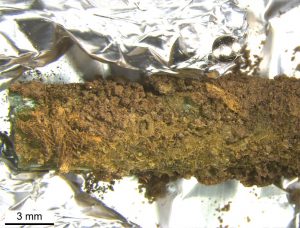
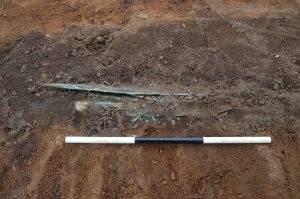 On Friday 9th September 2016, the GUARD Archaeologist monitoring the machine excavation of topsoil noticed something green just underneath the topsoil. Green is a sign of something with copper in it (like bronze) as this is the colour that oxidised copper turns. However, there was also a glint of gold, which is much more unusual (one of the reasons that gold is highly valued is that it doesn’t change colour like bronze or iron). While the green artefact appears to be a blade, the gold is decorated and appears to be part of a socket of another bronze artefact.
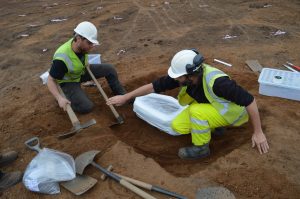 Owing to the fragile nature of these remains and that the site was going to be left open for the weekend, our team removed the entire pit (and the surrounding subsoil which it was cut into) as a single 80 kg block of soil. This was then delivered to our Edinburgh Office that same day, where it could be safely stored over the weekend.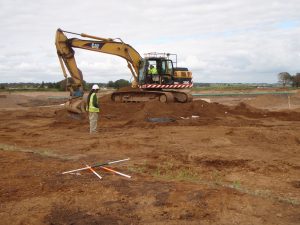
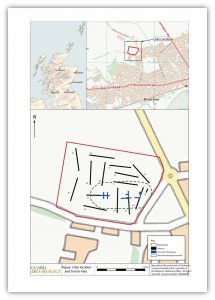 Archaeological evaluations are often required for planning developments where there is a potential for unknown archaeology to be encountered and which would otherwise be destroyed by proposed development. Though there were no known archaeological remains within the development area,