
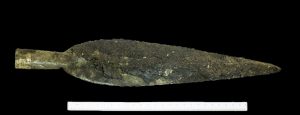
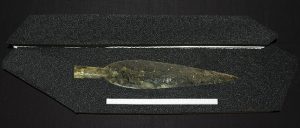
the Carnoustie spearhead
The Carnoustie spearhead was probably the star find of the dig. But it’s not the only gold decorated bronze spearhead to be found in this part of Scotland.
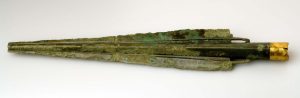
Pyotdykes spearhead © The McManus: Dundee’s Art Gallery and Museum
Another Bronze Age hoard was recovered at Pyotdykes farm just outside Dundee in 1963 and it too includes a gold decorated bronze spearhead. Indeed the discovery of the Carnoustie hoard spurred one of the specialists involved in our post-excavation programme of works, Alison Sheridan of the National Museums of Scotland to re-examine the Pyotdykes artefacts – two swords and the spearhead – which are held by The McManus – Dundee’s Art Gallery and Museum.
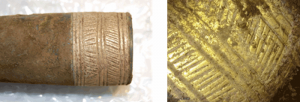
details of gold decoration of Carnoustie spearhead socket
Though a different shape to the Carnoustie spearhead, it is again the socket of the Pyotdykes spearhead which is embellished with a gold strip. The decoration on the Carnoustie band is decorated with a herringbone design between zones of two to three concentric lines,
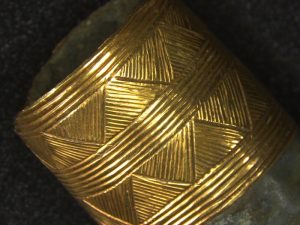
detail of gold decoration around Pyotdykes spearhead socket. Photo by Lore Troalen of NMS
The Pyotdykes band has a more elaborate scheme featuring filled triangles between zones of up to seven lines. In each case, the design was probably incised into the end of the bronze socket, and then a seamless hoop of thin gold foil was slipped over the end and pressed in, to take the design.
One of the Pyotdykes swords had been buried in a scabbard made from hazelwood, just as the Carnoustie sword had been. As with the Carnoustie hoard, this proved really useful in providing suitable material for radiocarbon dating. The Pyotdykes hoard is now dated to 900–790 BC, slightly later than the Carnoustie Hoard which was dated to between 1118-924 BC.
The dates are interesting because they suggest that the two hoards were probably not contemporary with each other but may have been separated in time by as much as 300 years. This makes the similarities between the hoards all the more fascinating because while these suggest a similar idea behind why they were buried – perhaps safe-keeping rather than ritual given that the Carnoustie hoard lies within the middle of a settlement unlike most hoards which were deposited in watery places (rivers, bogs, lochs) – it was not one event that spurred this. This cultural custom of burying precious possessions for safe-keeping (for whatever reasons) was probably practised in this region for several centuries in the Late Bronze Age. And for whatever reasons, those who buried the hoards at Carnoustie and Pyotdykes, never returned to reclaim them.
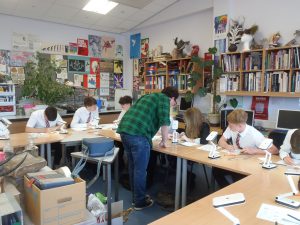 During the Artefacts Illustration workshop, the students were shown a selection of finds from Carnoustie (prehistoric stone tools, lithics and pottery) and were then asked to select one that they would like to draw. They then learned how to draw different types of artefacts by drawing around it then using dividers to measure and correct the outline. They also used a magnifier to add in detail and were given a small light to create a light source for shading. Once they had finished the pencil drawing they traced over it using fibre tipped pens to produce a final drawing.
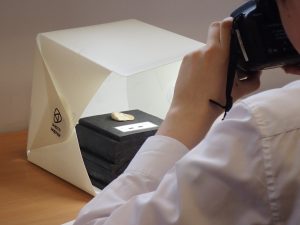 For the Artefacts Photography workshop, t
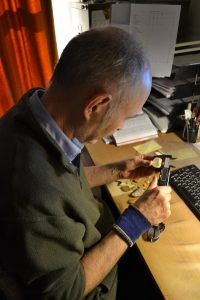 602 lithic artefacts were recovered from the Carnoustie excavation and subjected to analysis by Torben Ballin. He found out that the lithics mainly comprise flint and quartz but with some pitchstone and quartzite. About 92% of this assemblage is waste material produced in the making of prehistoric stone implements. The remaining 8% of the lithic artefacts are actual tools such as arrowheads, knives and scrapers.
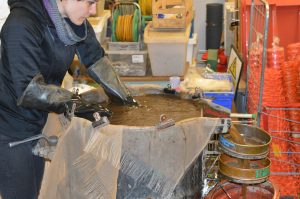 In March 2018, the final programme of post-excavation analyses of the archaeological remains at Carnoustie got underway with the wet-sieving of the soil samples taken during the excavation. This is the process by which we recover tiny minute environmental evidence (such as charred cereal grains) which might reveal the diet of the people who inhabited the site at Carnoustie during the Neolithic and Bronze Age.
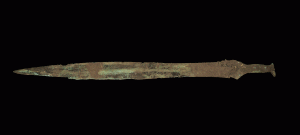 In January 2018, the specialist post-excavation analyses of the Carnoustie hoard was collated into a
  The spearhead had been wrapped in sheepskin when it was buried with the sword.
 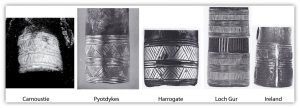 The Carnoustie spearhead is one of only five examples of spearheads adorned with gold binding in Britain and Ireland, the others being from Pyotdykes near Dundee, Harrogate in Yorkshire, Lough Gur in County Limerick in south-west Ireland and another from Ireland.
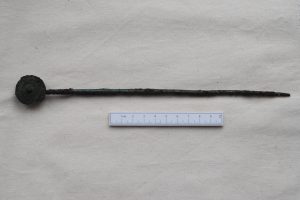 A complete but fragmented bronze sunflower-headed, swan’s neck bronze pin was found lying over the pommel, hilt and upper blade area of the sword, its head at the pommel end. Fragments of woven textile were associated with this pin, including in the narrow area between the shank and the back of the pinhead – thereby indicating that the pin had been used to securing the woolen cloth wrapped around the sword. Compositional analysis using X-ray fluorescence revealed that the pin, like the sword and the spearhead, is of leaded bronze.
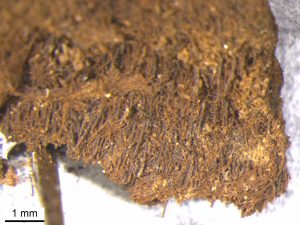 The fragments of textile were examined by Susanna Harris of the University of Glasgow using scanning electron microscopy, who concluded that all were of sheep’s wool, and that at least two different textiles were represented. One, found around the socket of the spearhead is a fine, tabby weave, woven using z-spun thread with one thread system finer that the other. The other, found associated with the pin and the annular mount that decorated the scabbard, is a slightly coarser fabric, woven with z-spun yarns with thread systems of similar diameter. There is no sign of any dye in either fabric.
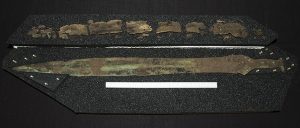 One of the key questions we had was: precisely how old was the Carnoustie hoard? This is where the wooden scabbard (identified
 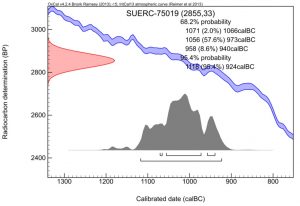 In September 2017, we received the radiocarbon date for the wooden scabbard from the Scottish Universities Environmental Research Centre in East Kilbride. The radiocarbon dating revealed a 95.4% that the scabbard dated to between 1118 BC and 924 BC. This is very significant new evidence because it not only dates the burying of the hoard to around 1000 BC but is one of the few direct scientific dates for such Late Bronze Age metalwork in Britain (because most of such metalwork has no organic remains that can be radiocarbon dated).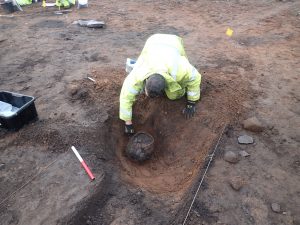
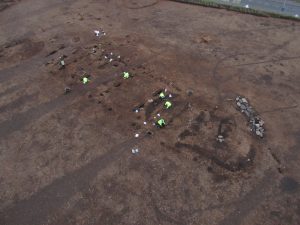 On 17 February 2017, the GUARD Archaeology team completed their excavation of the archaeological remains at Balmachie Road, Carnoustie. Altogether they had recorded the remains of up to 12 sub-circular houses that probably date to the Bronze Age along with the remains of two rectilinear halls that likely date to the Neolithic period. The Neolithic features are significant in themselves, and include the largest Neolithic Hall ever found in Scotland. The hoard was buried in a pit close to a roundhouse that cut through the large Neolithic hall.
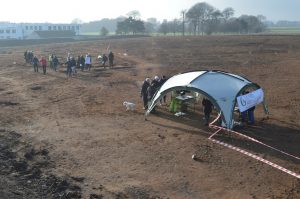 Over the
 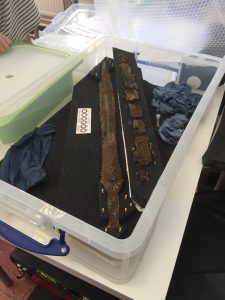 Normally post-excavation analyses of artefacts recovered from excavations only begins once the entire excavation has been completed. But in the case of the Carnoustie hoard, specialist analyses was required as soon as possible. This was because the organic remains within the hoard were so delicate and fragile that there was a danger that they would degrade within a very short time. They urgently needed conservation but before this could take place, specialists required to examine the remains and take appropriate samples for scientific testing (such as radiocarbon dating, isotope analyses, X-ray Fluorescence analyses) to extract crucial information about the artefacts.
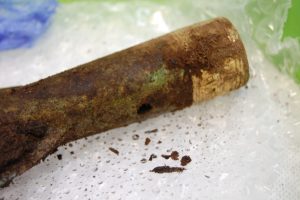 So post-excavation analyses of the hoard begins in January 2017 with a
 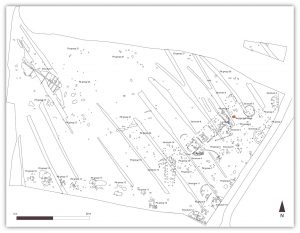 As the machine excavation of topsoil continued to reveal archaeological features so the archaeological excavation area continued to expand until by December 2016, the GUARD Archaeology team of nine archaeologists had discovered around 1000 archaeological features spread over a 17,700 sqm area.
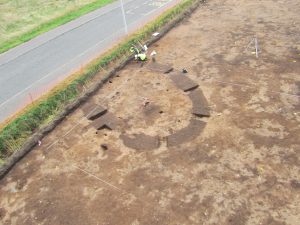 These features comprise numerous pits, post-holes and ditches. Many of these features are clustered together in patterns that can be recognised as house structures of various shapes, from elliptical, round and rectangular. From the various artefacts (pot sherds and flints mainly) that are beginning to be recovered, these houses appear to be prehistoric.